How Flexible Learning Is Redefining the Next Step in Education Careers
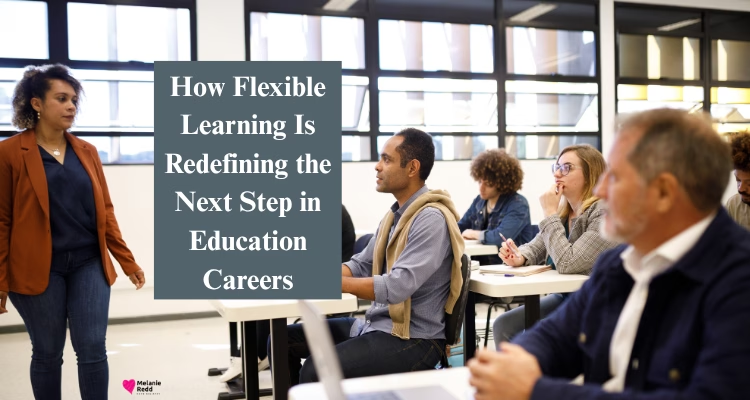
Education has never stood still, so why should your career?
The classroom you started in may look very different from the one you work in today, with new technology, changing student needs, and fresh approaches to teaching constantly influencing how educators work.
The qualification that helped you start your career might not be the one that takes you to the next stage. But that doesn’t mean you need to pause your career and return to full-time study, far from it. Today, professional learning can take many forms, from short courses and workshops to online study and targeted professional development.
For seasoned education professionals, ongoing learning isn’t just about obtaining more qualifications. It’s about staying curious, building practical skills, and staying open to new career opportunities.
Why Today’s Education Professionals Need to Keep Learning
The education sector is changing quickly, and the changes don’t stop when you receive your qualification. What worked well a decade ago will need a different approach today.
Technology is an obvious example. Digital tools, online learning platforms, and artificial intelligence are becoming part of everyday education, creating opportunities but also raising new questions about how students learn and how educators work.
Then there are the less obvious changes. Student expectations change, workplaces evolve, and new roles emerge in education. An experienced teacher may eventually find themselves interested in curriculum development, educational leadership, student support, learning design, training, or education technology.
Staying up to date with your skills means you can act when opportunities arise. It can also keep your work interesting. After years in the same role, learning something unfamiliar can provide a fresh challenge and perhaps remind you why you chose education in the first place.
Professional development doesn’t have to mean chasing every new trend. It means identifying what is relevant to your work, your interests, and where you might want your career to go next.
Skills That Can Strengthen an Education Career
The most useful skill isn’t always the one that leads directly to a promotion. Sometimes it’s the skill that gives you more options.
Digital confidence is one example. You don’t need to become a technology expert, but understanding digital learning tools and emerging technologies can make it easier to adapt as your workplace changes.
Communication remains just as important. The ability to explain ideas clearly, listen well, and communicate with different people is valuable across almost every educational role.
Leadership is another skill worth developing, even if you don’t plan to become a principal or manager. Leadership can mean mentoring a colleague, coordinating a project, supporting a team, or taking responsibility for improving something within your workplace.
Other useful areas to explore include:
- Learning design and curriculum development
- Digital literacy and technology
- Leadership and management
- Communication and collaboration
- Critical thinking and problem-solving
- Data literacy and evaluation
- Student wellbeing and support
- Project and time management
The trick is not to learn everything. Choose skills that connect with where you are now and where you want to go next. For example, if you’re considering further study, Master of Education courses online can help you develop deeper knowledge while still continuing to work.
Making Professional Development Work Around Your Life and Career
The biggest obstacle to professional development is often not motivation. It’s finding the time.
If you’re already working in education, your days may be full before you even think about studying. Add family, friends, exercise, and everything else that life throws at you, and another major commitment can feel unrealistic.
That’s where flexible learning can make a difference.
Online and part-time study can allow you to work towards a qualification without necessarily stepping away from your existing career. Short courses and targeted professional development can also help when you want to build a specific skill without committing to a longer programme.
Start with the problem you want to solve, rather than the qualification you think you should have. Maybe you want to move into leadership. You may be interested in technology or curriculum development. You might simply want to become better at something you already do.
Once you know what you’re trying to achieve, it’s easier to decide how much time, money, and study make sense.
And don’t underestimate small steps. One new skill can lead to a new responsibility, which can lead to a new opportunity. Professional growth doesn’t have to happen all at once. It can happen alongside the career and life you’ve already built.
Closing Thoughts
A career in education doesn’t have to follow a straight line. You can change direction, develop new interests, and discover opportunities you couldn’t see when you first qualified.
Continuing to learn helps keep those possibilities open.
The goal isn’t to study simply for the sake of another certificate. It’s to keep developing as an education professional while building a career that can adapt with you.
Your next step might be a qualification, a short course, a new skill, or simply the decision to keep learning. The important thing is to keep moving forward.
Were you encouraged by what you read?
Then, would you share this article with a friend, co-worker, or family member?
Or, maybe you can send it to a friend or family member?
This blog occasionally uses affiliate links and may contain affiliate links.
Additionally, Melanie Redd is a participant in the Amazon Services LLC Associates Program.
This is an affiliate advertising program designed to provide a means for sites to earn advertising fees. These are earned by advertising and linking to Amazon.com.
Also, for more on my disclosure policy, click HERE.
© Melanie Redd and Hope Ministry, 2026. Unauthorized use and/or duplication of this material without express and written permission from this blog’s author and/or owner is strictly prohibited.
Further, excerpts and links may be used, provided that full and clear credit is given to Melanie Redd and Hope Ministry.
Please give appropriate and specific directions to the original content.



0 Comments