How Continuous Learning Supports Effective Organizational Leadership
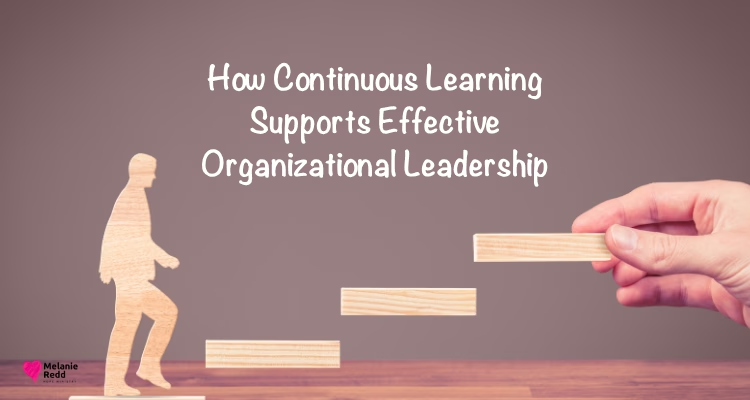
Humans have never really stopped asking “What’s next?”
We’ve migrated across continents chasing better hunting grounds, built libraries in Alexandria to hoard every scrap of recorded knowledge, and eventually decided the moon wasn’t off limits either.
That restlessness, the refusal to accept the current level of understanding as the final word, is the same trait that separates leaders who stagnate from leaders who actually move their organizations forward.
Curiosity isn’t a soft skill. Rather, it’s the operating system beneath every other leadership skill that gets discussed in boardrooms.
Shackleton and the Leadership Lesson Nobody Planned For
In 1915, Ernest Shackleton’s ship Endurance became trapped in Antarctic pack ice, crushed slowly over months until the crew had to abandon it entirely. Shackleton had planned a continental crossing.
What he got instead was an unplanned masterclass in adapting under pressure, navigating open ocean in a lifeboat, and keeping 27 men alive with no rescue in sight. Every one of them survived.
Shackleton’s success wasn’t because he stuck to his original plan, far from it. It was because he kept absorbing new information from a brutal environment and adjusting his entire strategy in real time. That’s continuous learning under the worst possible conditions. And it’s the same instinct modern leaders need when things change overnight.
Learning Doesn’t Stop Once You Get the Corner Office
Many folks believe that leadership development ends when you get the first big promotion, as if a title is proof that the learning phase is over.
Research on leadership competencies tells a different story, though. A recent phenomenological study on effective leadership strategies found that continuous learning, innovative thinking, and resilience through change were recurring traits among leaders who successfully navigated major disruptions like the pandemic and rapid technological shifts.
Intrapersonal competencies included personal growth through change, leadership through vision and resilience, continuous learning, innovative thinking and openness, and resilience in personal challenges, and these enabled leaders to maintain their competence in navigating organizational challenges. The leaders who kept learning stood their ground even amidst all the mayhem. The ones who assumed they’d already arrived were caught flat-footed.
Satya Nadella and the Culture Reset at Microsoft
When Satya Nadella took over as Microsoft’s CEO in 2014, the company was widely seen as slow, internally competitive, and stuck defending old products instead of building new ones.
Nadella pushed a shift toward what he called a “growth mindset” culture, encouraging employees and leadership to treat failure as information rather than a verdict, and to keep learning rather than defending existing turf.
The company’s cloud business and overall market value grew substantially in the years that followed. Whatever you think of the specifics, the underlying move was simple: leadership improved once learning got built back into the culture instead of being treated as something you did before you got promoted.
What the Research Actually Says About Learning and Performance
A qualitative review of learning-oriented leadership found that organizations depend on leaders who actively facilitate employee learning to stay competitive, since capabilities that were sufficient a few years ago quickly become outdated.
To remain competitive when AI models are running rampant and forcing upskilling, organizations need to continually enhance their employees’ competencies and capabilities, and the central role of leadership in facilitating employee learning is well documented in both academic literature and practitioner writing.
Separate research on leadership effectiveness found that leaders who were learning goal-oriented, along with being strong communicators and self-confident, had a measurably greater impact on organizational effectiveness.
This is likely because such leaders are learning goal-oriented, have good interpersonal communication skills, are self-confident, and exhibit certain behaviors which are more likely to have a greater impact on organizational effectiveness. Adaptability and good judgment under uncertainty come from years of staying in the habit of learning long after the diploma gets framed and hung on the wall.
That being said, getting that diploma is still important in many ways. Leadership development often grows out of structured academic pathways and continued learning experiences. Rockhurst University is one example of an institution where professionals can deepen their leadership capabilities and evolve their approach to leading teams and organizations over time.
Indra Nooyi and Staying a Student of the Business
Former PepsiCo CEO Indra Nooyi was known for treating every part of the business, from supply chains to shifting consumer health trends, as something worth studying rather than something she’d already mastered. She pushed PepsiCo toward healthier product lines years before it became an industry standard, a bet that required her to keep learning about nutrition science and changing consumer behavior rather than relying on what had worked for the company for decades.
Leaders who stop learning tend to keep making decisions based on a version of the world that no longer exists. Leaders who keep learning at least have a shot at making decisions based on the one that’s in front of them.
Building a Learning Habit Instead of a Learning Event
Both Shackleton and Nadella ended up somewhere their original plan didn’t account for, and both got through it by paying attention to what was actually in front of them, instead of what they’d expected.
That habit is hard to fake. A leader who keeps learning stays in sync with a business as it changes. One who stops learning keeps managing a company that mostly exists in their head, and usually doesn’t notice any changes until something forces them to.
That’s what learning does to good leadership.
Were you encouraged by what you read?
Then, would you share this article with a friend, co-worker, or family member?
Or, maybe you can send it to a friend or family member?
This blog occasionally uses affiliate links and may contain affiliate links.
Additionally, Melanie Redd is a participant in the Amazon Services LLC Associates Program.
This is an affiliate advertising program designed to provide a means for sites to earn advertising fees. These are earned by advertising and linking to Amazon.com.
Also, for more on my disclosure policy, click HERE.
© Melanie Redd and Hope Ministry, 2026. Unauthorized use and/or duplication of this material without express and written permission from this blog’s author and/or owner is strictly prohibited.
Further, excerpts and links may be used, provided that full and clear credit is given to Melanie Redd and Hope Ministry.
Please give appropriate and specific directions to the original content.




3 Comments
Sarah K. · 08/12/2026 at 11:57 AM
Such helpful and well-structured content! I appreciate the effort that went into this. I’ve shared it with friends who were asking about this exact topic. tinhgpa.com has been another resource we’ve found valuable alongside yours.
Casey T · 08/07/2026 at 8:56 AM
Such practical advice! I really appreciate the thoughtful, research-backed approach here. We’ve also been enjoying toontone.fun as a fun family activity resource — the kids love it. Great content!
helloredds@gmail.com · 08/10/2026 at 11:21 AM
Thanks, Casey!
Appreciate you and your comments.
Hope you have a wonderful day,
Melanie